Table of Contents
- Why Tuxedo Alterations and Suit Adjustments Are Priced Differently
- Tuxedo vs Suit: Construction Details That Affect Alteration Pricing
- Suit Jacket Tailoring Cost Calgary: What Affects Your Quote
- How Long Do Suit Alterations Take? Timelines for Tuxedos and Suits
- Best Practices for Formal Wear Fitting Before a Wedding or Gala
- Comparing Alteration Processes: Tuxedo vs Suit Adjustments
- Frequently Asked Questions
Last Updated: September 14, 2026
Why Tuxedo Alterations and Suit Adjustments Are Priced Differently
A tuxedo alteration almost always costs more than a comparable suit adjustment, and the reason comes down to fabric, not difficulty. Tuxedo alterations and suit adjustments pricing diverge because formal wear carries satin facings, braided trouser seams, and structured linings that a standard business suit does not. At Calgary Seamstress, we see this gap constantly: a client brings in a navy business suit for sleeve shortening and a black tuxedo for the same job, and the quotes land in different territory. The suit takes a straightforward seam. The tuxedo takes a seam plus careful handling of a finish that shows every needle mark.
That difference matters most in Calgary, AB, where wedding season and gala calendars cluster tightly between late spring and early fall. If you are booking suit adjustments near me two weeks before an event, knowing why one garment costs more than another helps you budget and helps you ask better questions. Understanding these price variations often leads to broader questions about how custom shirt costs align with the overall investment in a tailored wardrobe.
Here is the short version before we get into detail:
- Suit adjustments are usually priced by the number of seams touched and the fabric type.
- Tuxedo alterations add surcharges for satin, braiding, and the risk of visible repair marks.
- Rush timelines change the quote more than the garment type does.
Below, we break down exactly what drives each quote, how long the work takes, and what to prepare before your fitting.
Tuxedo vs Suit: Construction Details That Affect Alteration Pricing
The structural differences between a tuxedo and a business suit determine how much labor a tailor must invest. A tuxedo is not simply a black suit. Its lapels are faced with satin or grosgrain, its trousers often carry braided side seams, and its interior is built to hold a rigid shape through an evening of wear. Each of those features adds steps to an alteration.
Lapel Facing and Satin Trim
Satin facing is the single biggest reason tuxedo lapel work costs more. When a tailor shortens or reshapes a satin-faced lapel, the facing must be detached, trimmed, and reattached so the sheen runs in one continuous direction. A needle hole in satin does not close the way it does in wool (britannica.com). One misplaced stitch and the lapel shows a permanent mark. That risk is priced in.
Trouser Braiding and Side Seams
Braided side seams on tuxedo trousers cannot simply be cut and resewn like a plain seam. The braid must be removed, the seam adjusted, and the braid reapplied by hand so the pattern stays aligned down the full leg. On a standard suit trouser, the same adjustment takes a fraction of the time because there is no decorative trim to preserve.
Suit Jacket Tailoring Cost Calgary: What Affects Your Quote
Suit jacket tailoring cost in Calgary depends on four variables: the number of adjustments, the fabric, the garment’s construction quality, and your deadline. A single sleeve shortening on a wool suit jacket is a quick job. A full jacket recut with shoulder work, waist suppression, and sleeve rotation is a different project entirely.
Here is how the main factors stack up:
|
Factor |
Effect on Quote |
Why It Matters |
|---|---|---|
|
Number of seams |
Each seam adds labor |
Sleeves, waist, and shoulders are separate jobs |
|
Fabric type |
Satin and delicate weaves cost more |
Higher risk of visible marks |
|
Construction quality |
Fused vs. canvassed jackets differ |
Canvassed jackets allow cleaner recuts |
|
Timeline |
Rush work adds cost |
Compressed schedules need priority handling |
|
Lining work |
Adds a step |
Lining must be opened and resewn |
A common mistake is assuming all jacket work is priced the same. It is not. Waist suppression on a canvassed jacket is a genuinely different operation from the same job on a fused garment, and the quote should reflect that. If a quote seems unusually low for complex jacket work, ask what is actually included.
How Long Do Suit Alterations Take? Timelines for Tuxedos and Suits
Most suit alterations take between three days and two weeks, depending on the scope of work (ITAM Chapter 13). A simple hem or sleeve adjustment can be ready in a few days. A full jacket recut with shoulder and waist work typically needs one to two weeks so the garment can be fitted, adjusted, and pressed properly between stages.
Tuxedo alterations often run slightly longer than equivalent suit work for one reason: the finishing steps take more time. Satin facings and braided seams are handled by hand, and handwork cannot be rushed without visible results.
A practical timeline looks like this:
- Simple hem or sleeve length: a few days
- Waist suppression or taper: about one week
- Full jacket recut: one to two weeks
- Tuxedo with satin and braid work: add a few days to the suit equivalent
- Rush service: same-day or next-day turnaround is possible when the shop offers it
If your event is close, say so at the first fitting. Tailors can often prioritize, but only if they know the deadline from the start. Waiting until the second fitting to mention a date is the most common way clients end up stressed.
Best Practices for Formal Wear Fitting Before a Wedding or Gala
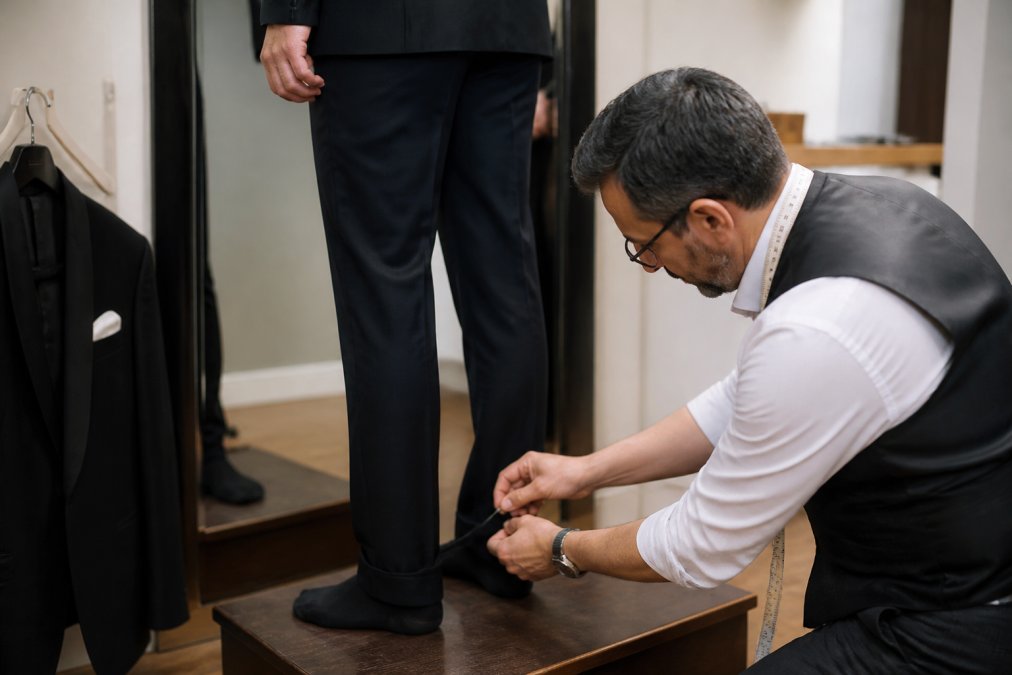
Book your first formal wear fitting at least six to eight weeks before the event, and bring the exact shoes, shirt, and undergarments you plan to wear (theknot.com). Fit is cumulative. A jacket that sits perfectly over a dress shirt can pull awkwardly over a thicker one, and trouser break changes completely with heel height.
A few habits separate a smooth fitting from a frustrating one:
- Wear the shoes you will wear to the event
- Bring the shirt and any undergarments you plan to use
- Bring the full outfit, not just the piece being altered
- Note your event date and share it at the first appointment
- Ask how many fittings the quote includes
- Confirm the pickup date in writing
For wedding parties and gala groups, stagger appointments so each person gets individual attention. Group fittings move fast and details get missed. A jacket that fits one groomsman well may need different work on another, and treating them as one batch is how sleeves end up uneven.
Comparing Alteration Processes: Tuxedo vs Suit Adjustments
The core difference in process is handwork versus machine work. Suit adjustments lean on machine seams for speed and consistency. Tuxedo alterations lean on hand finishing because the decorative elements cannot survive a machine pass without damage.
|
Process Step |
Suit Adjustment |
Tuxedo Alteration |
|---|---|---|
|
Seam opening |
Machine |
Often by hand |
|
Trim handling |
None |
Satin and braid preserved |
|
Reattachment |
Machine stitch |
Hand stitch on trim |
|
Pressing |
Standard |
Low-heat, directional |
|
Fitting rounds |
One to two |
Usually two |
|
Risk level |
Lower |
Higher due to visible finish |
That risk level is why a tuxedo quote runs higher even when the visible change looks identical to a suit job. The tailor is not charging more for the same stitch. They are charging for the care required to make that stitch invisible.
At Calgary Seamstress, we handle both, and the honest answer is that most clients only need the tuxedo-level care once or twice in their lives. For everyday suit adjustments, a standard process is entirely appropriate. Matching the process to the garment is what keeps your quote fair.
Choosing between tuxedo alterations and suit adjustments pricing comes down to understanding what each garment demands, and the gap is rarely as large as it first appears. The real challenge is finding a tailor who explains the difference instead of just quoting a number.
Calgary Seamstress offers wedding dress alterations, suit tailoring, and rush service with one-hour or 24-hour turnaround options from our Calgary Southcentre Mall location. Our artisans handle complex work like satin facings, braided seams, and structured jacket recuts, and we walk you through every step so the final fit reflects what you actually asked for. Get started with Calgary Seamstress and book a fitting that respects both your garment and your timeline.
Frequently Asked Questions
Why are tuxedo alterations generally more expensive than suit alterations?
Tuxedo alterations often cost more because of the garment’s construction. Satin lapel facings, braided trouser sides, and lined jacket panels require more careful handling and hand-finishing to avoid visible needle marks or puckering. The fabric itself, often finer wool or blends, leaves less room for error. Suit adjustments on standard business suits typically involve simpler seams and fewer decorative elements, which keeps labor time and pricing lower. Always request a written quote based on your specific garment.
How long do suit alterations take for a wedding or formal event?
Standard suit alterations usually take one to two weeks, but tuxedo alterations with satin or braided details can take longer because of the hand-finishing involved. During peak wedding season in Calgary, book at least four to six weeks before your event. Rush services are available at some shops, including Calgary Seamstress, which offers one-hour and 24-hour rush options for urgent fittings. Confirm turnaround times when you book your first fitting.
What is included in suit jacket tailoring cost Calgary?
Suit jacket tailoring cost Calgary depends on the scope of work. Common adjustments include sleeve shortening, waist suppression, lapel reshaping, and shoulder alterations. Sleeve and waist adjustments are simpler and cost less; shoulder work requires opening the jacket and is priced higher. Tuxedo jackets with satin lapels add complexity because the facing must be re-shaped without damaging the sheen. Request an itemized quote so you can see exactly what each adjustment contributes to the total.
Do tuxedo lapels require specialized tailoring services?
Yes. Satin and grosgrain lapel facings on tuxedos are delicate and show pin marks, so a tailor needs experience handling these materials. Reshaping a peak or shawl lapel without creating ripples in the satin takes patience and the right needle and thread.