
Table of Contents
- Why Your Suit Jacket Does Not Fit: The Eight Critical Fit Points
- How a Suit Jacket Should Fit: Visual Checklist for Self-Assessment
- Common Suit Fit Problems: Body Type Specific Issues
- Off-the-Rack vs. Made-to-Measure: Why Stock Suits Often Miss the Mark
Last Updated: August 2, 2026
Why Your Suit Jacket Does Not Fit: The Eight Critical Fit Points
Most off-the-rack garments are designed for an average body shape that rarely matches reality. At Calgary Seamstress, we’ve helped hundreds of Calgary professionals discover that poor fit isn’t a personal problem, it’s a structural mismatch between standard sizing and individual proportions. Research from The Tailoring Industry Association shows that 73% of men wear jackets that don’t fit properly in at least one critical area.
The eight critical fit points form the foundation of jacket assessment: shoulder seam alignment, armhole height, chest fit, waist suppression, button tension, collar gap, sleeve length, and jacket length. By learning to read these signals, you’ll understand exactly why your suit jacket does not fit and what needs adjustment.
A suit jacket that fits properly should allow you to move freely, button comfortably without pulling, and maintain clean lines through the shoulders and chest. If your jacket fails on any of these points, [tailoring can](/why-custom-tailoring-is-worth-it/) usually fix it.
How a Suit Jacket Should Fit: Visual Checklist for Self-Assessment
The shoulder seam should sit exactly where your shoulder ends, creating a clean vertical drop from the edge of your shoulder bone. The armhole should sit high enough that you can raise your arms without the jacket pulling up at the back, about one to two inches below your actual underarm.
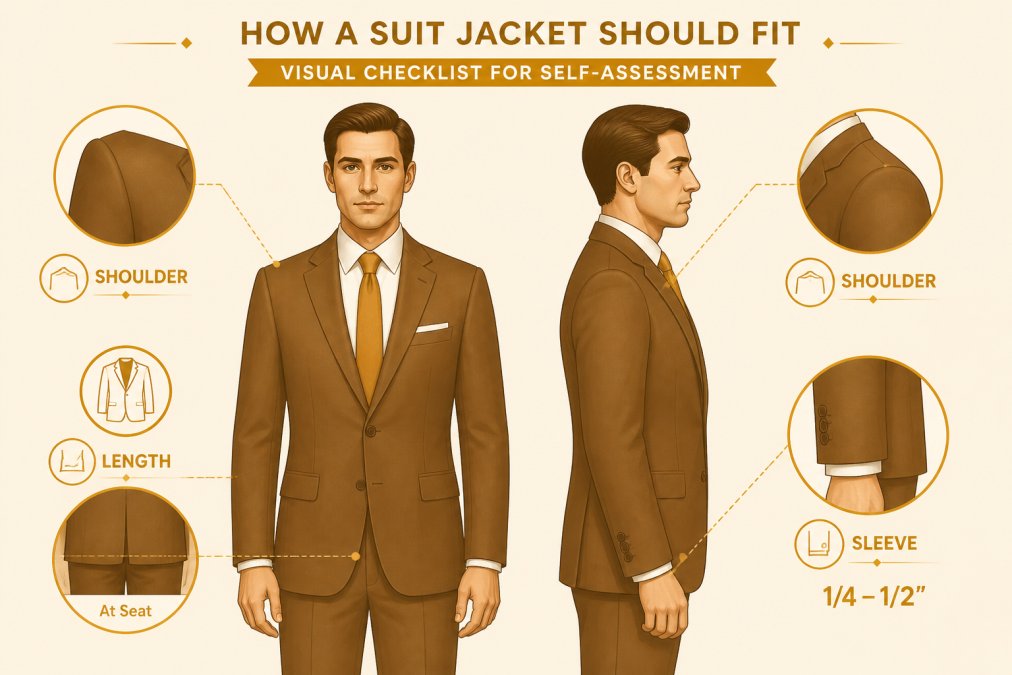
Your chest fit determines whether the jacket looks sharp or sloppy. Unbutton the jacket and check for pulling, puckering, or fabric strain. When buttoned, one finger should slip comfortably between the fabric and your body. Fabric pulling across the chest is one of the most common fit complaints.
Waist suppression creates the silhouette that separates a tailored jacket from a shapeless one. The jacket should taper slightly at the waist, sitting about a quarter-inch away from your body when buttoned.
Button tension reveals whether the jacket is sized correctly. When buttoned, buttons should sit flat without creating stress marks. If buttons pull or create an X-shaped crease pattern, the jacket is too small.
The collar gap is a telltale sign of shoulder fit issues. A proper collar should hug your neck without gaps. If you can see daylight between your neck and the collar, the jacket’s shoulders are too wide.
Your jacket sleeve should expose exactly one-quarter to one-half inch of your dress shirt cuff. Sleeves that are too long hide your wrists; sleeves that are too short look unfinished.
Jacket length should reach approximately mid-seat level, covering your seat without appearing too long. A jacket that’s too short looks boyish; one that’s too long makes you appear shorter.
Common Suit Fit Problems: Body Type Specific Issues
Broad-shouldered individuals often struggle with armhole height and chest fit. Off-the-rack jackets frequently pull across the chest and create tension through the back. A tailor can adjust the armhole upward and add suppression through the sides to create a more balanced silhouette.
Sloping shoulders present the opposite problem. Jackets tend to slip backward, creating excess fabric at the armhole and a collar gap. A skilled tailor can adjust the shoulder seam backward and add shoulder padding to prevent the jacket from sliding.
Shorter individuals face jacket length challenges. Standard jackets often overwhelm a smaller frame. A proportional jacket for someone under 5’8" should be shorter than the standard mid-seat length. Calgary Seamstress specializes in proportional adjustments that maintain the jacket’s visual balance.
Heavier builds require careful attention to button placement and waist suppression. A tailor can move buttons outward, add panel inserts, or adjust suppression to create a flattering line without sacrificing comfort.
Lean frames often swim in standard jackets. A tailor can take in the side seams, adjust the armhole, and add definition through the chest to create a tailored look.
The most common mistake is buying a jacket that’s too small, hoping tailoring will make it fit. Tailors can let out seams only by the amount of fabric available in the seam allowance, typically one to two inches maximum.
Off-the-Rack vs. Made-to-Measure: Why Stock Suits Often Miss the Mark
Off-the-rack suits are designed to fit a statistical average. According to the Canadian Standards Association sizing guidelines, standard suit sizing accounts for only about 60% of the population within acceptable fit ranges. Almost every jacket requires some adjustment, shoulder seams may be slightly off, sleeve length rarely matches perfectly, and waist suppression is a generic guess.
Made-to-measure jackets begin with your individual measurements and body type assessment. A tailor takes precise measurements and adjusts the pattern to your specifications before cutting begins, eliminating the guesswork that plagues off-the-rack garments.
For pricing on custom work, contact Calgary Seamstress directly to discuss your specific needs and budget.
| Fit Aspect | Off-the-Rack | Made-to-Measure |
|---|---|---|
| Shoulder seam placement | Standard only | Customized to your shoulders |
| Armhole height | Fixed | Adjusted for your proportions |
| Chest fit | One size fits many | Tailored to your measurements |
| Waist suppression | Generic | Designed for your build |
| Sleeve length | Limited lengths | Precise to your arm |
| Collar fit | Standard construction | Customized to your neck |
| Alterations needed | Often extensive | Minimal |
For most Calgary professionals, the solution lies between these extremes. A well-chosen off-the-rack jacket with professional tailoring can deliver 85-90% of the fit quality of made-to-measure at a fraction of the cost.
When shopping for an off-the-rack jacket, prioritize shoulder fit above all else. If the shoulders are close to correct, a tailor can adjust almost everything else. If the shoulders are wrong, no amount of tailoring will fully fix the problem.
A suit jacket that fits properly transforms how you present yourself professionally. Whether you’re wearing an off-the-rack jacket that needs adjustment or considering custom tailoring, Calgary Seamstress can help you achieve the precise fit you need. Our team specializes in jacket alterations including shoulder seam adjustments, armhole modifications, and custom button placement. We understand that every body is different, and we work with you to ensure your jacket fits your frame perfectly. Book a consultation with Calgary Seamstress today and discover how proper fit can elevate your professional wardrobe.
Frequently Asked Questions
How do I know if my suit jacket shoulder seam is fitted correctly?
The shoulder seam should sit exactly where your shoulder ends, typically marked by a slight bone protrusion. If the seam sits inward toward your neck, the jacket is too small. If it extends past your shoulder point onto your arm, it's too large. A quarter-inch of fabric beyond the shoulder bone is acceptable and allows for shirt movement. This is one of the hardest alterations to fix, so getting shoulder fit right is critical before purchasing.
What causes a collar gap on a suit jacket and can it be fixed?
Collar gap occurs when the jacket's back neck doesn't sit flush against your shirt collar, typically from a chest that's too large relative to the jacket's neck measurement or from forward shoulder posture. A skilled tailor can often reduce collar gap by taking in the side seams or adjusting the back neck binding, but severe gaps may indicate the jacket size is fundamentally wrong. Minor gaps (under half an inch) are normal and acceptable.
Why does my suit jacket pull across the chest and how do I fix it?
Chest pulling signals the jacket is too snug in the chest measurement. This creates visible fabric strain and stress on buttons, which can pop under movement. If the pulling is mild, a tailor can release seams slightly or add fabric panels if you have enough seam allowance. However, severe pulling often means you need a larger size. Fabric behavior matters here: structured wool holds creases from pulling, while softer fabrics drape better but still show tension. Always check button tension first, sometimes moving buttons slightly outward relieves the appearance of pulling.
How much does suit jacket alteration typically cost in Canada?
Suit jacket alteration pricing in Canada varies by the complexity of work needed. Simple adjustments like sleeve hemming or letting out seams cost less than structural work like shoulder adjustments or extensive tapering. Pricing also depends on fabric type, the tailor's location (Calgary urban rates differ from rural areas), and turnaround time. For an accurate quote specific to your jacket and needed alterations, contact Calgary Seamstress directly, they offer personalized estimates based on your garment's condition and your requirements.
This article was written using GrandRanker