Last Updated: October 25, 2026
Quick Summary
Most clothing fit issues are fixed by adjusting existing seams rather than cutting new ones, since removing fabric is easy but putting it back is not. Take in side seams gradually on oversized tops, stabilize knits before cutting, and reset shoulders or shorten sleeves on jackets to correct pulling and sagging.
- Pin oversized garments inside out and taper smoothly from underarm to hem, stopping before the armhole.
- Elastic can be added or replaced to bring a baggy waistband back in without cutting the denim.
- Always stabilize a knit before cutting it, or the fabric will unravel or distort.
- Diagonal wrinkles usually mean the grain line was off during cutting, so re-cut or adjust the seam angle.
- Bring the garment clean and pressed, and describe the problem rather than naming the fix.
Table of Contents
- Why Custom Clothing Fit Issues Happen in the First Place
- How to Fix Clothes That Are Too Big Without Losing Their Shape
- Jacket Fit Issues and Alterations: Shoulders, Sleeves, and Seams
- Sweater Fit and Alterations for Knits That Stretch or Sag
- What Causes Pulling, Puckering, and Wrinkles in a Finished Garment
- Your Tailor Fitting Appointment Checklist Before You Arrive
- Book Your Fitting and Get the Fit You Actually Want
- Frequently Asked Questions
Why Custom Clothing Fit Issues Happen in the First Place
Most fit problems start long before the sewing machine. They begin with a measurement taken on the wrong day, a fabric that behaves differently than expected, or a body that sits between two standard sizes.
A clothing fit issue is any gap between how a garment was cut and how it actually sits on your body. That gap shows up as pulling, sagging, twisting, or extra fabric.
At Calgary Seamstress, we see the same handful of causes week after week:
- Body changes. Weight shifts, posture, and muscle tone move inches around.
- Fabric behavior. Wool, denim, and knits each relax or shrink at their own rate.
- Standard sizing. Off-the-rack patterns assume a body that few people have.
- Wear and wash. Heat and tumbling break down fibers over time.
A common mistake is blaming your body for a garment that was never cut for it. Before attempting a DIY fix, it helps to review common clothing repair mistakes to avoid. The fix belongs to the garment, not to you.
How to Fix Clothes That Are Too Big Without Losing Their Shape
The safest fix for oversized clothing is to take in the seams that already exist, not to cut new ones. Removing fabric is easy; putting it back is not.
Taking in Side Seams on Oversized Tops and Dresses
Side seams are the friendliest place to start. Turn the garment inside out, pin along the existing seam line, and taper gradually from underarm to hem.
- Pin first, then try the garment on inside out.
- Keep the taper smooth; sharp angles create puckers.
- Stop the new seam before the armhole so you don’t distort it.
- Press the seam flat as you go.
Watch out: taking in both sides by the same amount can shift the garment’s balance and pull the neckline off-center.
Reshaping Waistbands and Pant Legs That Bag Out
Baggy waistbands and stretched pant legs are usually a tension problem, not a size problem. Elastic can be added or replaced to bring the waist back in without cutting the denim. If your jeans are loose at the waist or you want to skip the belt, our team can add an elastic waist to your jeans while keeping the original look. If your jeans are loose at the waist or you want to skip the belt, our team can add an elastic waist to your jeans while keeping the original look.
For pant legs that flare out at the knee, taper from the inner leg seam. Take small amounts and check the drape after each pass.
Jacket Fit Issues and Alterations: Shoulders, Sleeves, and Seams
Jacket fit issues and alterations come down to three zones: the shoulder, the sleeve, and the seam. The shoulder is the hardest to change. The sleeve is the easiest.
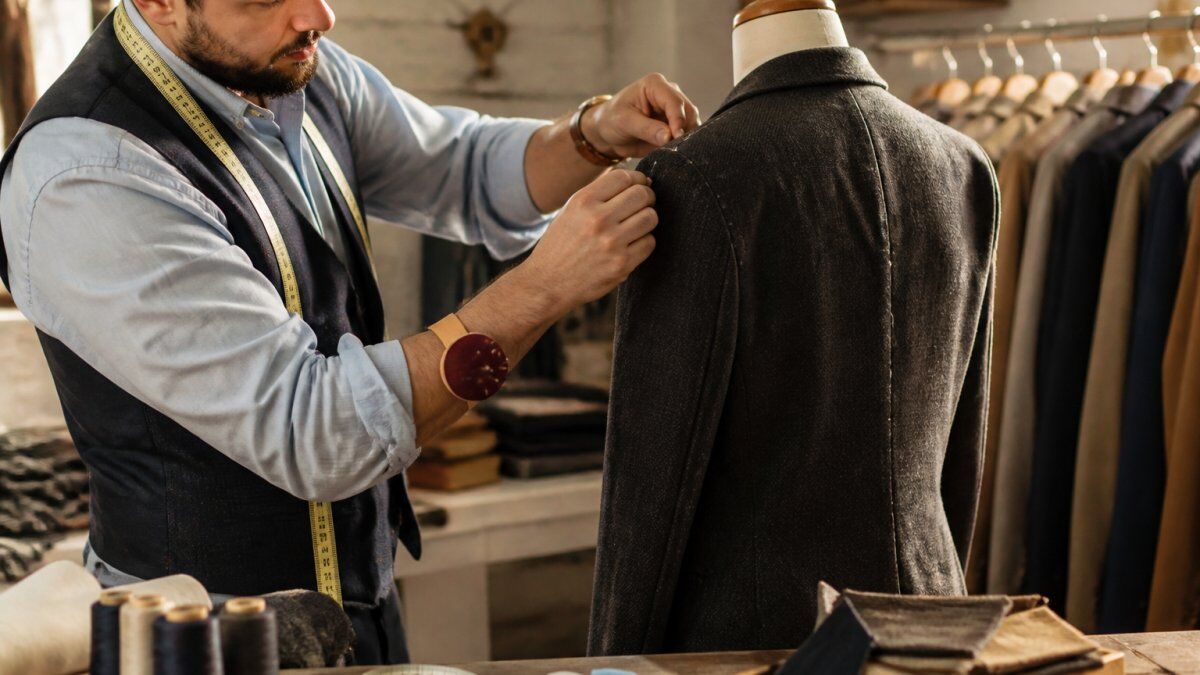
Shoulder seams should land at the edge of your shoulder bone. If they hang past it, the jacket is too big. If they dig in, it’s too small. Resetting a shoulder is skilled work, and a rushed job leaves visible puckering.
Sleeve length is a simpler fix. A tailor can shorten from the cuff or, on some jackets, from the shoulder. Sleeves that bunch at the wrist need shortening, not stretching.
If a jacket feels short in the body, don’t replace it yet. Our team can lengthen a jacket that’s too short using matching fabric or a hidden hem extension. Our team can lengthen a jacket that’s too short using matching fabric or a hidden hem extension.
The real difference between a jacket that looks tailored and one that looks altered comes down to pressing. Every seam needs to be pressed as it’s sewn, not after.
Sweater Fit and Alterations for Knits That Stretch or Sag
Sweater fit and alterations follow different rules than woven fabrics. Knits stretch, so any fix must account for movement, not just static measurements.
Sagging shoulders and stretched cuffs are the usual complaints. Here’s how we approach them:
- Stretched cuffs and hems: re-knit or add a hidden elastic band inside the ribbing.
- Sagging shoulders: shorten the seam slightly and reinforce with a stabilizing tape.
- Too-long body: shorten from the hem, then re-block the knit to restore shape.
- Baggy sleeves: taper from the underarm seam in small steps.
A common mistake is cutting a knit without stabilizing it first. The fabric will unravel or distort. Always secure the edge before you cut.
Wash knits in cold water and dry them flat. Heat is what ages a sweater fastest.
What Causes Pulling, Puckering, and Wrinkles in a Finished Garment
Pulling, puckering, and wrinkles in a finished garment almost always trace back to tension. Either the fabric was stretched during sewing, or the seam was sewn too tight for the material.
Here’s the pattern we see most:
| Problem | Likely Cause | Fix |
|---|---|---|
| Pulling at the bust or back | Seam too tight for the fabric | Let out the seam and re-sew with ease |
| Puckering along a seam | Uneven feed or stretched fabric | Unpick and re-sew with stabilizer |
| Diagonal wrinkles | Grain line off during cutting | Re-cut or adjust the seam angle |
| Wrinkles at the shoulder | Shoulder seam set too high | Reset the shoulder seam |
| Twisting hem | Fabric cut off-grain | Re-hem on the true grain |
If you’ve already tried a repair and made it worse, stop. Some fixes are easy to reverse; others aren’t. The Canadian Standards Association publishes care-label guidance that helps you understand what a garment’s manufacturer expects, which is a useful starting point before any alteration.
Your Tailor Fitting Appointment Checklist Before You Arrive
A tailor fitting appointment checklist saves time and gets you a better result. For practical guidance on measurements and communication, see these tips for successful custom garment fitting. Arrive prepared and the fitting takes one visit instead of three.
- Wear the undergarments and shoes you’ll pair with the garment.
- Bring the garment clean and pressed.
- Note the exact spots that feel wrong, and where.
- Bring any accessories that change the fit, like a belt or scarf.
- Know your deadline before you walk in.
- Ask what the tailor recommends, then say what you actually feel.
- Confirm the pickup date in writing.
The biggest mistake clients make is describing the fix instead of the problem. Say “it pulls here when I raise my arm,” not “take in the sleeve.” A good tailor wants to see you move.
Book Your Fitting and Get the Fit You Actually Want
Fit problems are fixable, and most take less time than people expect. The key is catching them early and trusting the work to someone who does it daily.
At Calgary Seamstress, our Southcentre Mall studio in south Calgary handles everything from jeans and pant alterations to suit tailoring and blouse and top alterations. We offer a one-hour or 24-hour rush service when your timeline is tight, and every piece is handled by our own team.
If you’re not sure what your garment needs, bring it in. We’ll tell you honestly what’s worth fixing and what isn’t. You can book an appointment online and get the fit you actually want. You can also explore our full range of seamstress services before you come in.
Frequently Asked Questions
How do you fix custom clothes that are too big?
A tailor takes in the garment at the side seams, waistband, or back seam to remove excess fabric while keeping the original proportions. For tops and dresses, side seams are usually the first adjustment. Pants often need the waistband reduced and the seat reshaped. The key is removing fabric in stages and trying the garment on between passes so the drape stays natural. A fitting appointment lets you confirm the fit before any stitching is finalized.
Can a tailor fix custom clothing that is too tight?
Sometimes, depending on how much seam allowance is left inside the garment. Tailors can let out side seams, center back seams, and hems by the width of the allowance. Jackets and trousers made with generous allowances have more room to work with. If the fabric has already been trimmed close to the stitch line, a tailor may add a gusset or matching panel instead. Bring the garment in for an assessment before assuming it cannot be saved.
How can you tell whether a jacket fits properly?
Check three areas: the shoulder seam should sit at the edge of your shoulder bone, the sleeve should end at the wrist bone, and you should be able to button the jacket without the fabric pulling into an X across the chest. Run your hands down the lapels; they should lie flat. Raise your arms; the jacket should not ride up dramatically. Any gap or strain at these points signals a jacket fit issue a tailor can usually correct.
When should you take a fit issue to a professional tailor?
Take it in when the fix involves structural seams, linings, or fabrics you are not confident cutting. Jacket shoulders, lined garments, and knits are good examples. Also go professional when the garment is high-end or sentimental and a mistake would be costly. A tailor fitting appointment checklist helps you arrive prepared with the garment, the shoes you will wear with it, and notes on where it pulls or sags.
Your clothes should move with you, not against you. Calgary Seamstress can make that happen with expert alterations, a rush service when you need it, and a local team that treats every garment like it matters. Get started with Calgary Seamstress and wear clothes that finally fit.