Table of Contents
- Act Quickly: Assess the Fit Issue
- Wedding Dress Alterations Too Tight: Immediate Steps
- How to Talk to Your Seamstress About Alterations
- Wedding Dress Fitting Checklist: What to Bring and Check
- Wedding Dress Alterations Timeline: How Much Time You Have
- Solutions When There Isn’t Enough Fabric to Let Out
- Preventing Fit Problems in Future Fittings
- Frequently Asked Questions
Last Updated: October 18, 2026
Act Quickly: Assess the Fit Issue
When your wedding dress doesn’t fit after alterations, the first step is staying calm and evaluating what’s actually wrong. A dress that feels slightly snug in one spot is different from one that won’t zip or restricts your movement.
Start by putting on the dress with your wedding shoes and undergarments. This matters. Your shoes change how you stand, and the right undergarments affect how the dress sits.
Check the specific areas that feel wrong
Walk through your dress slowly. Pay attention to where it pulls, binds, or gaps. Write down the exact spots:
- Does it tighten across the bust?
- Is the waistline sitting too high or low?
- Does the zipper struggle to close?
- Do the seams pucker or strain?
- Does the back feel too loose or too tight?
Be specific. “The dress is tight” doesn’t help. “The dress pulls across my shoulder blades and the back seam is puckering” gives your seamstress something to work with.
Distinguish between normal discomfort and a real problem
New dresses feel different. They’re stiff. The fabric hasn’t moved with your body yet. Some initial tightness can loosen up naturally after you wear it for a few hours.
A real fit problem shows these signs:
- You can’t move your arms freely
- You can’t sit down comfortably
- The zipper won’t close all the way
- Seams are visibly puckering or twisting
- The dress pulls away from your body in gaps
- You can’t breathe deeply
If the dress feels snug but you can move, sit, and breathe normally, it may just need a day or two of wear to settle. If movement is genuinely restricted, you need to act immediately.
Wedding Dress Alterations Too Tight: Immediate Steps
A dress that’s too tight after alterations needs quick assessment. The good news is that many tight dresses can be fixed. The challenge is time and available fabric.
Check seam allowances and fabric give
Most wedding dresses have seam allowances, extra fabric folded inside the seams. A skilled seamstress can release these to add a quarter inch to half inch of extra room.
Look at the inside of the dress. Can you see folded fabric along the seams?
Some fabrics stretch slightly with wear and body heat. Satin, stretch velvet, and blended fabrics often give a bit. Rigid fabrics like structured taffeta or heavy brocade don’t stretch.
Determine if the dress can be let out
“Letting out” a dress means releasing the seams to add width. How much can be let out depends on:
- How much seam allowance exists
- Whether the dress has a lining that also needs adjusting
- The dress style (some styles have less room to work with than others)
A seamstress can typically let out between a quarter inch and an inch per seam, depending on the dress. That might be enough. It might not be. This is why you need a professional assessment quickly.
Don’t assume the dress can’t be fixed. Talk to your seamstress before you panic.
How to Talk to Your Seamstress About Alterations
Communication is everything when a dress needs fixing. The wrong conversation can waste time. The right one gets results.
Document the problem with photos or notes
Before your appointment, take notes or photos. Show exactly where the dress is tight. If you take photos, wear the dress with your shoes and undergarments so the fit is accurate.
Write down:
- Which seams are tight
- How much room you need (can you pinch an inch of fabric, or is it completely snug?)
- When your wedding is
- What you’ve already tried
Bring this to your appointment. It saves time and shows you’re organized.
Schedule a fitting appointment immediately
Don’t wait. Call your seamstress today. Explain that the dress is too tight and you need an urgent appointment. Many seamstresses in Calgary keep rush slots available for situations like this.
Be honest about your timeline. If your wedding is two weeks away, say so. Your seamstress needs to know whether this is a standard fix or a rush job.
Be specific about what needs to change
During the fitting, show your seamstress exactly where the dress is tight. Don’t just say “it’s too snug.” Point to the seams. Demonstrate the movement you need. Show how much room you want, pinch the fabric to show the amount.
Ask these questions:
- Can you let out the seams?
- How much room can you add?
- Will that be enough, or do we need another solution?
- How long will it take?
- What’s the cost?
Listen to your seamstress. They’ve handled hundreds of dresses. If they say a particular seam can’t be released much, trust that. If they suggest a different solution, ask why.
Wedding Dress Fitting Checklist: What to Bring and Check
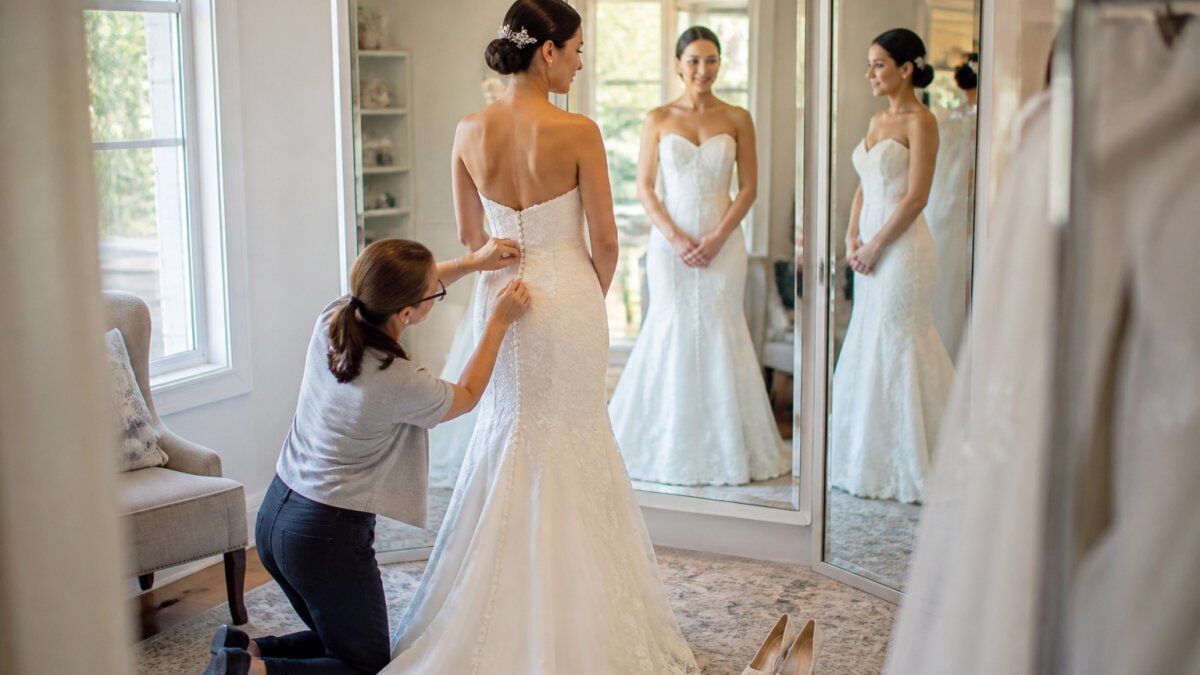
Your fitting appointment needs to replicate your wedding day as closely as possible. Small details change everything.
Wear your wedding shoes and undergarments
This is non-negotiable. Your shoes affect posture and how the dress hangs. The wrong undergarments can make the dress sit differently. Wear exactly what you’ll wear on your wedding day.
Bring your wedding day undergarments in a bag if you prefer. Change into them at the seamstress’s studio.
Test movement in key positions
At your fitting, try these movements:
- Sit down in a chair
- Stand up from the chair
- Reach your arms across your body
- Raise your arms to shoulder height
- Walk around the fitting area
- Turn side to side
If the dress restricts any of these movements, tell your seamstress immediately. The dress needs to allow you to move like a human being, not a statue.
Many brides discover during fitting that a dress they thought was fine actually limits movement. This is exactly why you test it now, not on your wedding day.
Wedding Dress Alterations Timeline: How Much Time You Have
Time pressure is real when alterations go wrong. Understanding turnaround expectations helps you plan.
Most standard alterations take two to three weeks. A dress that needs letting out, hemming, and other fixes typically requires this timeframe. Your seamstress needs time to do the work properly.
Understand turnaround expectations for fixes
If your dress is too tight and needs seams released, expect:
- Initial fitting and assessment: same day or next available appointment
- Actual alterations: five to seven business days for standard work
- Final fitting: two to three days after alterations are complete
- Total time: ten to fourteen days minimum
This assumes no complications. If the fix requires panel inserts or other creative solutions, add another week.
Plan for rush services if needed
Calgary seamstresses often offer rush services. If your wedding is sooner than two weeks away, ask about expedited work.
Be realistic about rush timelines. A seamstress cannot safely rush complex work. If the fix requires careful hand-stitching or multiple fittings, even rush work takes time.
If your wedding is fewer than seven days away, your options narrow significantly. Focus on the most critical fixes and accept that some adjustments may not be possible.
Solutions When There Isn’t Enough Fabric to Let Out
Sometimes seams can’t be released enough. The dress is too tight and letting out the existing seams won’t solve it. This is where creative solutions matter.
Panel inserts and strategic fabric additions
A skilled seamstress can add fabric panels to increase room. These panels are sewn into existing seams or strategically placed to add width without looking obvious.
The best panel inserts:
- Match the original dress fabric as closely as possible
- Follow the dress design so they look intentional
- Add room where it’s needed most (usually the side seams or back)
- Blend seamlessly with the original construction
Panel inserts work best on dresses with seams running vertically or in places where added fabric looks like part of the design. On a dress with minimal seaming, panels are harder to hide.
Design modifications that work with your dress style
Some dresses can be modified in ways that add room and look intentional:
- Converting a fitted back to a corset-style lacing (adds two to four inches)
- Adding a side zipper instead of a back zipper (allows the dress to open wider)
- Adjusting the neckline or armholes to release tension elsewhere
- Adding a bustle or train that shifts weight and changes how the dress hangs
These modifications require a seamstress who understands design. Not every alteration specialist can execute them well.
The key is working with someone who sees the dress as a whole design, not just a garment to be altered.
Preventing Fit Problems in Future Fittings
The best solution is preventing the problem in the first place. If you’re planning future alterations or working with a new seamstress, these steps reduce the risk.
Schedule multiple fittings before final alterations
Don’t do all alterations at once. Schedule fittings in stages:
- First fitting: initial assessment and basic adjustments
- Second fitting: after two weeks of wear to see how the dress settles
- Third fitting: final tweaks and completion
This approach catches problems early. If something isn’t right after the first round of alterations, you have time to fix it before moving forward.
Many brides skip the second fitting to save time. This is where mistakes happen. After wearing the dress for two weeks, you understand how it actually fits your body.
Communicate clearly about your vision from the start
Before any alterations begin, have a detailed conversation with your seamstress:
- Show photos of how you want the dress to fit
- Explain your movement needs
- Describe any discomfort you’re experiencing
- Ask questions about what’s possible
A seamstress who listens and asks clarifying questions is someone worth keeping. They’re thinking about your needs, not just the technical work.
At Calgary Seamstress, we start every wedding dress alteration with a thorough consultation. We ask about your vision, your comfort needs, and your timeline. We explain what’s possible and what isn’t. This conversation prevents most fit problems before they happen.
A wedding dress that doesn’t fit after alterations is stressful, but it’s rarely unsolvable. We specialize in wedding dress alterations and have handled countless situations like yours. Make an Appointment Online to discuss your specific fit problem and get a realistic timeline and solution plan.
Frequently Asked Questions
What should I do if my wedding dress doesn’t fit after alterations?
Contact your seamstress immediately. Bring the dress, your wedding shoes, and undergarments to a fitting appointment. Explain exactly which areas feel uncomfortable, too tight, too loose, or pulling in specific spots. A skilled seamstress can assess whether the dress can be adjusted further and what solutions are possible. If you’re close to your wedding date, mention that so they can prioritize your appointment.
Can a wedding dress be let out if it’s too tight after alterations?
It depends on how much seam allowance remains. If the seamstress didn’t cut away all the extra fabric, there may be room to release seams and let the dress out further. However, if the seams were trimmed too close or the dress was altered at multiple points, letting it out may not be possible. Your seamstress can inspect the dress and tell you what’s feasible within your timeline.
How close to my wedding can alterations be fixed if the dress doesn’t fit?
Many seamstresses offer rush or 24-hour services for wedding emergencies. Contact your seamstress as soon as you notice a fit problem, don’t wait. If you’re within 1-2 weeks of your wedding, inform them immediately so they can schedule you for expedited work. The sooner you address the issue, the more options you’ll have to correct it without compromising quality.
What if there isn’t enough fabric to let out my wedding dress?
If the seams can’t be released further, your seamstress may suggest panel inserts using matching or complementary fabric, or strategic design modifications like adding lace panels, beading, or restructuring seams to create more room. These solutions work best when planned early. Discuss creative options with your seamstress rather than accepting an ill-fitting dress.