Last Updated: November 4, 2026
Quick Summary
Bespoke suits are drafted from scratch for your body, with a pattern made by hand from your own measurements and posture. Made-to-measure suits start from a standard block and are adjusted to your measurements, which is faster and usually costs less. Choose bespoke suits if you have hard-to-fit proportions or want the most precise fit.
- Bespoke suits begin with a blank sheet and a pattern drafted by hand for your frame alone.
- Made-to-measure suits start from a standard block and change sleeve, jacket and trouser measurements.
- Made-to-measure is faster and usually costs less, though its shape stays closer to the block.
- Bespoke commissions usually involve at least two fittings, and clients with posture differences may need a third.
- Book your first fitting well before the date you need the suit, since multiple fittings take several weeks.
Table of Contents
- What Separates Bespoke Suits From Made to Measure
- Bespoke Suit Benefits in Fit, Construction and Longevity
- The Custom Suit Fitting Process From First Visit to Final Fitting
- Made-to-Measure Suit Alterations and What They Can Fix
- The Hidden Costs and Timelines to Plan For
- How to Choose a Custom Suit for Your Calgary Lifestyle
- Booking Your First Fitting With Calgary Seamstress
- Frequently Asked Questions
What Separates Bespoke Suits From Made to Measure
Bespoke suits and made-to-measure suits both promise a better fit than off-the-rack, but they start from very different places. The difference shows up in the first fitting. A bespoke suit is built around your body from scratch. A made-to-measure suit starts from an existing template and is adjusted to your measurements.
How a Pattern Is Drafted From Scratch
A bespoke suit begins with a blank sheet of paper, not a stock size. The tailor takes a detailed set of measurements, including posture, shoulder slope, and the way you carry your weight. From those measurements, the pattern is drafted by hand for your frame alone.
This matters most for people who do not fit standard proportions. A bespoke pattern can account for an uneven shoulder, a longer torso, or a seated posture that off-the-rack cuts ignore. The pattern becomes a one-of-one document, and the first muslin fitting tests it before any final cloth is cut.
Where Made to Measure Starts From a Block
Made-to-measure tailoring works differently. The tailor starts with a block, a pattern built to a standard body shape, and modifies it to match your measurements. Sleeve length, jacket length, waist suppression, and trouser break can all be changed without redrafting the whole garment.
Made-to-measure is faster and usually costs less. The trade-off is that the underlying shape stays closer to the block. For a client with an average build and standard posture, that trade-off is often acceptable. For a client who has struggled to find a good fit anywhere, it can leave small problems unresolved.
Bespoke Suit Benefits in Fit, Construction and Longevity
The main benefit of a bespoke suit is fit that responds to your body rather than a generic shape. Shoulder construction, armhole height, and chest shaping are all set to your measurements from the start. Many clients notice the difference most when they move: the jacket keeps its line when they sit, reach, or walk.
Construction is the second advantage.
Longevity follows from construction. When you are deciding, ask how the jacket is built, not only how it looks on the day of the first fitting.
The Custom Suit Fitting Process From First Visit to Final Fitting
The fitting schedule is where bespoke and made-to-measure diverge most in practice, and it is the part of the process most clients underestimate.
Stage 1: Consultation and Measurement
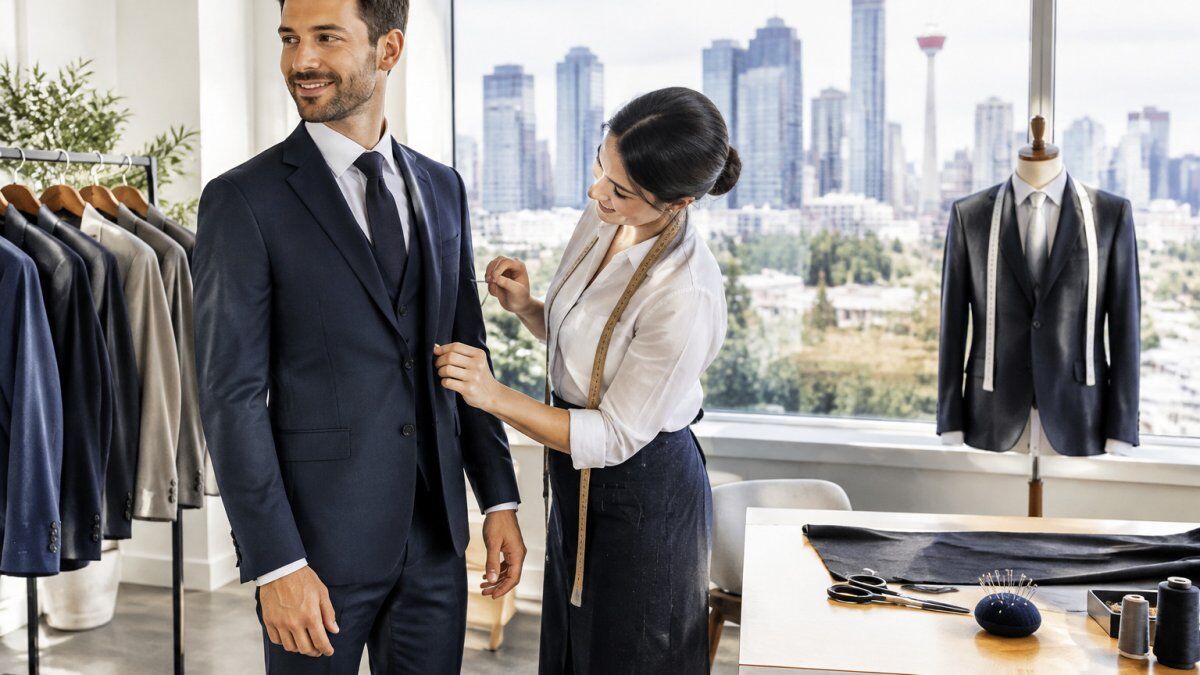
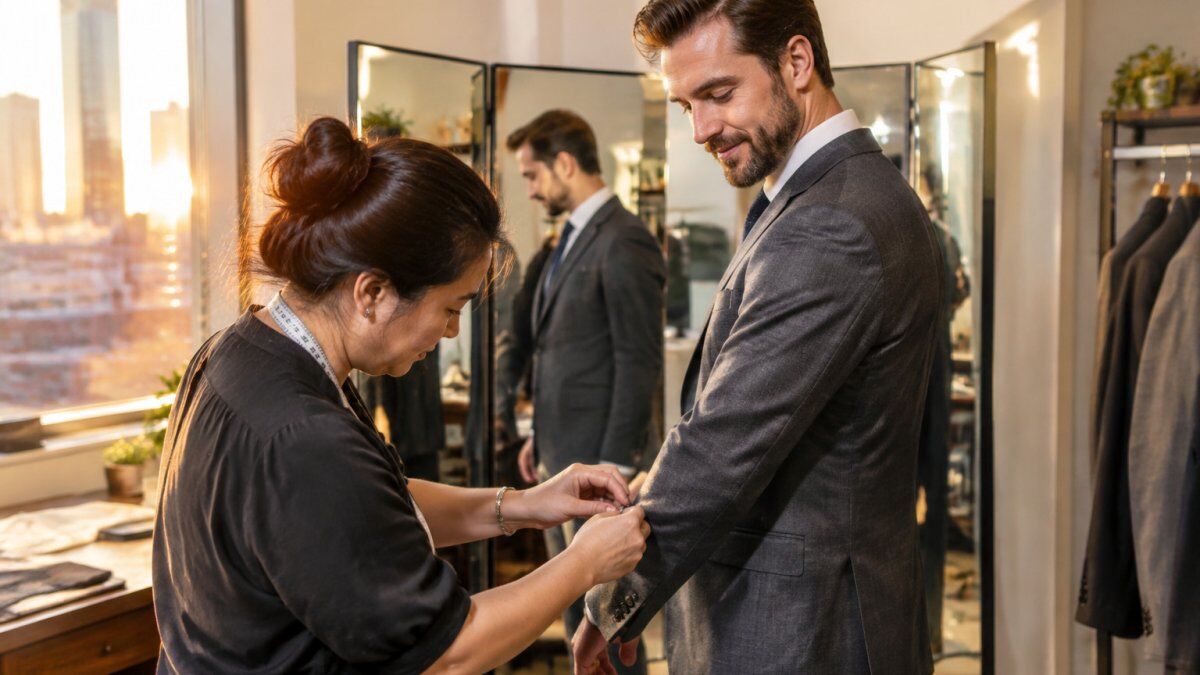
The first visit is a working session, not a sales pitch. The tailor records measurements and, just as importantly, notes posture: shoulder slope, the set of the neck, how the chest sits, and whether one hip is higher than the other. These notes become the reference for every later fitting. Bring the shoes you plan to wear with the suit, because heel height changes trouser length and break.
Stage 2: The Baste Fitting
For bespoke work, the first try-on is usually a basted garment, held together with temporary white stitching so the tailor can take it apart and re-cut. This is where balance is checked: whether the jacket hangs level front to back, whether the collar sits cleanly on the neck, and whether the sleeve pitch matches how your arms actually hang. Adjustments are marked in chalk directly on the cloth. A muslin toile may be used instead for clients with significant asymmetry, because it is cheaper to recut than the final cloth.
Stage 3: The Second Fitting
After the baste is corrected, the garment is re-cut and reassembled for a second fitting. Sleeve length, jacket length, waist suppression, and trouser line are refined here. Most bespoke tailors find two fittings is the minimum for a clean result, and clients with pronounced posture differences often need a third.
Stage 4: The Final Fitting
The final fitting happens when the suit is nearly finished. Only small changes should remain: lifting a trouser break, taking in the waist a touch, confirming button stance and lining. If major structural changes are still being marked at this stage, the earlier fittings were rushed.
How Fitting Counts Differ Between the Two Methods
Watch out: book your first fitting well before the date you need the suit, because a bespoke commission with multiple fittings can run several weeks, and a late start leaves no room to correct a problem found at the final fitting.
The fitting stages below summarise what each visit covers, so you can plan your schedule.
| Stage | What happens | Note |
|---|---|---|
| Consultation and measurement | Tailor records measurements and posture | Bring the shoes you plan to wear |
| Baste fitting | Temporary stitching checks balance and sleeve pitch | Adjustments marked in chalk on the cloth |
| Second fitting | Sleeve, jacket length, waist and trouser line refined | Two fittings is the minimum for a clean result |
| Final fitting | Only small changes remain | Major changes here mean earlier fittings were rushed |
Made-to-Measure Suit Alterations and What They Can Fix
Suit alterations can address many common fit problems.
Trousers are often the easiest to improve. Tapering the leg, adjusting the rise, or changing the break can make a suit look much more deliberate. For a step-by-step look at tapering, see How to Taper Suit Pants Properly in 2026, which covers the process in detail.
The Hidden Costs and Timelines to Plan For
The sticker price of a suit is rarely the full cost. Bespoke work involves multiple fittings, and each visit takes time away from work or other commitments. Factor in travel to and from fittings, and the schedule can stretch over several weeks.
Timelines depend on the work involved, so confirm the timeline with Calgary Seamstress before you commit.
Pricing depends on the garment, the work required, and the timeline, so contact Calgary Seamstress directly for a current quote.
How to Choose a Custom Suit for Your Calgary Lifestyle
Most tailoring guides are written for a generic climate and a generic office. Calgary is neither. The city swings from deep, dry cold in winter to warm, dry summers, with a short fall that can turn cold quickly. That range should drive your fabric and construction choices more than any trend.
Fabric Weight for Calgary’s Seasons
For fall and winter wear, a mid-to-heavy wool handles Calgary’s cold and wind better than a lightweight summer cloth. Flannel and tweed are practical choices for fall jackets and sport coats because they insulate without bulk and drape well over a sweater. A fully lined jacket is worth considering for winter, because it adds warmth and helps the jacket keep its shape under a coat.
Construction for Real Calgary Wear
If you commute, sit through long meetings, or spend time outdoors between appointments, a canvas-built jacket holds its shape through repeated wear and re-pressing better than a fused one. That matters in a city where a suit may be worn under a parka for part of the day and in a warm office for the rest. Ask how the chest piece is built before you choose the cloth.
Dressing for Calgary’s Business-Casual Culture
Calgary’s professional dress code leans more business-casual than formal, which changes what a suit needs to do. A softer, less structured jacket in a flannel or tweed pairs well with knitwear and trousers and gets more wear than a sharply structured formal suit. If you want one garment that works across the week, a mid-weight sport coat in a versatile color will earn its place more than a second formal suit.
Fit Still Comes First
Whatever fabric and construction you choose, a suit that fits your shoulders, chest, and seat will look better and wear better than one chosen for its cloth alone. Match the fabric and build to how you actually live in Calgary, then let the fit do the rest.
Booking Your First Fitting With Calgary Seamstress
If you are considering a bespoke or made-to-measure suit, the first step is a consultation. At Calgary Seamstress, we handle suit tailoring alongside pants alterations and jacket adjustments, so you can bring in an existing suit as well as a new order.
Book your first appointment through the Calgary Seamstress booking page and bring any suit you already own that needs work.
Frequently Asked Questions
What is the difference between bespoke and made-to-measure suits?
A bespoke suit is cut from a pattern drafted from scratch for one client, using their own measurements and posture notes. A made-to-measure suit starts from an existing block pattern that is adjusted to your measurements. Bespoke work usually involves more fittings, more hand-finishing and a wider choice of construction, while made-to-measure offers a faster, more affordable route to a well-fitting suit. Contact Calgary Seamstress for current pricing and timelines.
How many fittings does a bespoke suit usually require?
Bespoke suits typically involve several fittings, because the pattern is drafted and then refined in muslin before the final cloth is cut. The exact number depends on the cut, the fabric and how your posture and proportions are assessed. Made-to-measure suits generally need fewer visits.
Can a made-to-measure suit be altered after it is made?
Yes. Made-to-measure garments can usually be adjusted after they are finished, such as taking in or letting out the waist, shortening sleeves or tapering trousers. Major changes to the shoulders or chest are harder to correct and may be limited by the original construction.
How do I choose between bespoke and made-to-measure in Calgary?
Start with how often you will wear the suit, how precise the fit needs to be and how much time you have. If you need a suit for a specific event on a tight schedule, or you have an average build that suits standard proportions, made-to-measure is often the practical choice. If you have a distinctive build, want a unique cut or plan to keep the suit for many years, bespoke is worth considering.