Table of Contents
- Why Custom Tailoring Is Worth It: Fit, Comfort, and Individuality
- Benefits of Custom Suits vs. Off-the-Rack Garments
- Cost of Custom Tailoring in Canada: Investment vs. Value
- The Custom Tailoring Process: What to Expect From First Fitting to Final Garment
Last Updated: July 30, 2026
Understanding why custom tailoring is worth it comes down to a single truth: most bodies don’t match the sizing grids that mass-market clothing is built around. At Calgary Seamstress, we see this reality every day, off-the-rack purchases sit wrong in the shoulders, pull at the hips, or break at the wrong point. A well-fitted suit or dress changes your posture, confidence, and how others perceive you. According to research on clothing and social perception from the Journal of Experimental Psychology, the fit and quality of clothing measurably influences how competence and status are attributed by others.
Why Custom Tailoring Is Worth It: Fit, Comfort, and Individuality
Custom tailoring solves the fundamental problem that mass-produced clothing cannot: the human body doesn’t conform to standardized sizing. A custom or made-to-measure garment is cut to your actual measurements, posture, and proportions.
The fit advantages are specific: shoulder seams sit exactly at the edge of your shoulder, trouser breaks fall precisely where you want them, jacket suppression follows your actual waist, and sleeve length accounts for your arm length. Comfort follows directly from fit, garments that don’t pull, bunch, or gap allow full range of motion. Individuality is the third pillar: custom tailoring gives you control over fabric weight, lining, button placement, lapel width, and construction details. Your garment reflects your personal style rather than a trend cycle. For brides especially, a wedding dress made to your exact body and aesthetic is a different category of experience.
When discussing fit with your tailor, be specific about how you want the garment to feel, not just how you want it to look. Describe whether you want room to move freely or a closer silhouette.
Benefits of Custom Suits vs. Off-the-Rack Garments
Off-the-rack suits aren’t inherently inferior in fabric quality, but they are built to compromise. The canvas molds to your body over time, improving drape. This is the core of the cost-per-wear argument: a garment lasting ten years has a dramatically lower cost per wear than a cheaper suit replaced every two years.
| Factor | Off-the-Rack | Made-to-Measure | Bespoke |
|---|---|---|---|
| Fit precision | Standardized sizing | Your measurements | Full pattern from scratch |
| Fabric choice | Limited selection | Curated options | Full fabric library |
| Construction | Machine-sewn, fused | Mixed | Hand-stitched, canvas |
| Longevity | Moderate | High | Very high |
| Alterations needed | Often yes | Minimal | None |
Made-to-measure adjusts a base pattern to your measurements. Bespoke builds a pattern entirely around your body. Both outperform off-the-rack for fit. Custom tailoring also lets you choose fabric weight appropriate to Calgary’s climate, heavier wools for winter and lighter weaves for summer.
Avoid assuming alterations can fully fix an off-the-rack garment with major fit issues. Moving a shoulder seam is an extensive alteration that can cost nearly as much as a made-to-measure option. If fit issues are structural, custom is often more economical.
Cost of Custom Tailoring in Canada: Investment vs. Value
The cost-per-wear framework clarifies the value calculation. A garment worn 50 times over five years has a very different per-use cost than one worn twice. Custom pieces tend to be worn more often because they fit well and feel good. According to the Textile and Fashion Federation’s guidance on garment longevity and sustainability, well-constructed garments with quality fabric last significantly longer than fast fashion alternatives, directly reducing long-term clothing expenditure.
Custom tailoring is the opposite of fast fashion: one garment, made well, worn often, maintained properly. For Canadians aware of the environmental cost of clothing production, this is meaningful. A well-constructed custom garment requires proper dry cleaning and storage, but because the construction is sound, it’s far less likely to develop puckered seams, collapsed shoulders, or broken linings.
The real cost of custom tailoring isn’t the upfront price. It’s the price divided by the number of times you wear it over its lifespan. A garment worn for a decade almost always wins that calculation.
The Custom Tailoring Process: What to Expect From First Fitting to Final Garment
The custom tailoring process is a structured sequence of consultations, measurements, fittings, and adjustments that transforms your requirements into a finished garment.
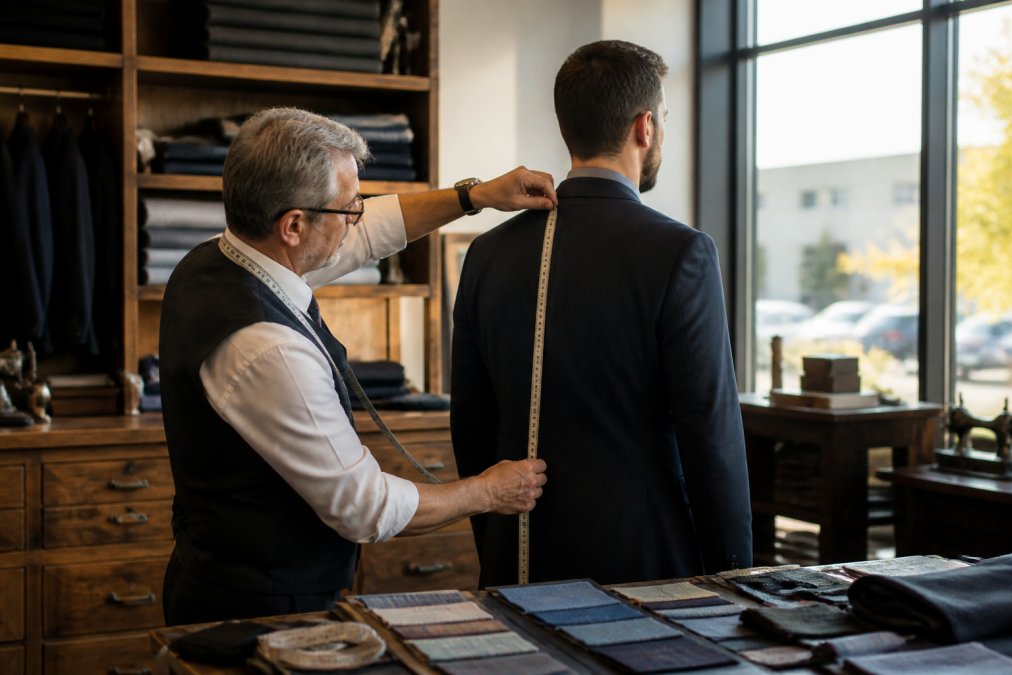
Here’s what the typical process looks like:
- Initial consultation: Discuss garment type, occasion, style preferences, and specific requirements.
- Measurements: Precise measurements are taken across all relevant points.
- Fabric selection: Choose from available options suited to your climate and occasion.
- Pattern making: For bespoke work, a pattern is drafted from scratch. For made-to-measure, a base pattern is modified.
- First fitting (baste fitting): The garment is assembled loosely so fit can be assessed and adjusted.
- Adjustments: The tailor marks and makes corrections based on the fitting.
- Final fitting: The finished garment is tried on with minor tweaks if needed.
- Collection: The garment is pressed and ready.
A skilled tailor asks questions and listens. You don’t need a complete design brief, describing the occasion, your body concerns, and your general aesthetic is enough. The tailor translates that into construction decisions. As documented in the Canadian Apparel Federation’s overview of domestic tailoring and garment services, skilled garment construction in Canada draws on both traditional techniques and contemporary pattern-making methods.
Custom tailoring is particularly significant for clients with body-type challenges. Broad shoulders with a narrow waist, longer torsos, petite frames, or asymmetrical proportions are all accommodated naturally. There’s no need to size up for one area and alter the rest, the garment is built around your actual body from the start.
Finding clothing that genuinely fits is harder than it should be, especially for formal occasions. Calgary Seamstress specializes in custom garment design, bespoke creation, and meticulous alterations for wedding dresses, suits, and formal attire. Whether you need a dress altered to fit flawlessly or a custom piece built from scratch, the team brings the craftsmanship and attention to detail the work demands. Make an appointment online and get a garment that actually fits the body you have.
Frequently Asked Questions
What are the main benefits of custom tailoring over buying off the rack?
Custom tailoring delivers a precise fit based on your exact measurements, which off-the-rack garments simply cannot replicate. Beyond fit, you choose your fabric weight, quality, and silhouette to suit your personal style. Garments are built with superior construction techniques, often hand-stitched with a full canvas, making them more durable. For Calgarians investing in wedding attire, business suits, or formal wear, custom tailoring ensures both comfort and a polished professional image that lasts.
How much does a custom tailored suit or garment cost in Canada?
The cost of custom tailoring in Canada varies considerably depending on the complexity of the garment, fabric selection, and the level of service, whether made-to-measure or fully bespoke. Factors like fabric quality, the number of fittings, and any rush service requirements all affect pricing. Because every project is unique, the best approach is to book a consultation with your tailor to receive an accurate quote tailored to your specific garment and needs.
How long does the custom tailoring process take in Canada?
Timelines depend on the garment type and the tailor's workload. A bespoke suit or custom wedding dress typically requires several weeks to allow for pattern making, fittings, and adjustments. However, many Calgary tailors, including those offering rush services, can accommodate tighter timelines for alterations or simpler custom pieces. If you have a firm event date, communicate it clearly at your first appointment so your tailor can plan accordingly.
Is custom tailoring only worth it for formal wear like suits and wedding dresses?
Not at all. While custom tailoring is especially impactful for high-stakes garments like wedding attire and business suits, the benefits extend to everyday wardrobe staples. Well-fitted trousers, jackets, and even casual pieces all benefit from precise alterations. Custom tailoring is also worth considering for cherished or high-end garments that deserve expert repair rather than replacement, zipper replacements, cuff adjustments, and hem corrections all fall within a skilled tailor's scope.
What is the difference between bespoke and made-to-measure tailoring?
Made-to-measure starts from a base pattern that is adjusted to your measurements, offering a strong fit at a more accessible price point. Bespoke tailoring creates a unique pattern built entirely from scratch around your body, involving multiple fittings and a higher degree of customization. Both deliver far superior fit and individuality compared to off-the-rack options, but bespoke represents the pinnacle of garment construction, craftsmanship, and personal style expression.
This article was written using GrandRanker