Table of Contents
- What You’ll Need Before You Start Tapering
- How to Measure Leg Opening for Pants That Fit Right
- Step-by-Step: How to Taper Suit Pants Properly
- Suit Pant Break Styles Explained
- Suit Pants Alteration Cost Calgary: What to Expect
- Common Mistakes to Avoid When Tapering Suit Pants
- Conclusion
- Frequently Asked Questions
Last Updated: September 23, 2026
What You’ll Need Before You Start Tapering
Tapering suit pants is the process of narrowing the leg from the knee down to the hem so the fabric follows the shape of your leg instead of hanging straight. Done well, it transforms a boxy off-the-rack pair into something that looks made for you.
At Calgary Seamstress, we handle suit tailoring every week, and the difference between a clean taper and a ruined pair almost always comes down to preparation.
Gather these before you touch a needle:
- Fabric chalk or a disappearing marker
- Straight pins and a measuring tape
- A seam ripper
- Sharp fabric scissors
- Matching thread and a sewing machine
- An iron and pressing cloth
- A pair of pants you already like the fit of
One more thing: press the pants flat before you start. Wrinkled fabric shifts under the machine, and you will pin a crooked line without noticing.
Never cut fabric before you baste and try the pants on. Cutting is permanent. Basting takes ten extra minutes and saves the whole garment.
How to Measure Leg Opening for Pants That Fit Right
The right leg opening depends on the look you want, not a single universal number. A classic taper lands around 18 to 19 centimetres at the hem for most men, while a slim taper sits closer to 16.5 centimetres.
Here is how to measure it correctly:
- Lay your best-fitting pants flat on a table.
- Smooth the leg so the inseam and outseam line up.
- Measure straight across the hem, edge to edge.
- Double that number for the full opening.
- Measure at the knee too, so you know where the taper should start.
Write both numbers down. Most people forget the knee measurement, then wonder why the taper looks abrupt.
For a fuller breakdown of how leg opening connects to overall fit, the Threads Magazine guide to trouser fit walks through the proportions in detail.
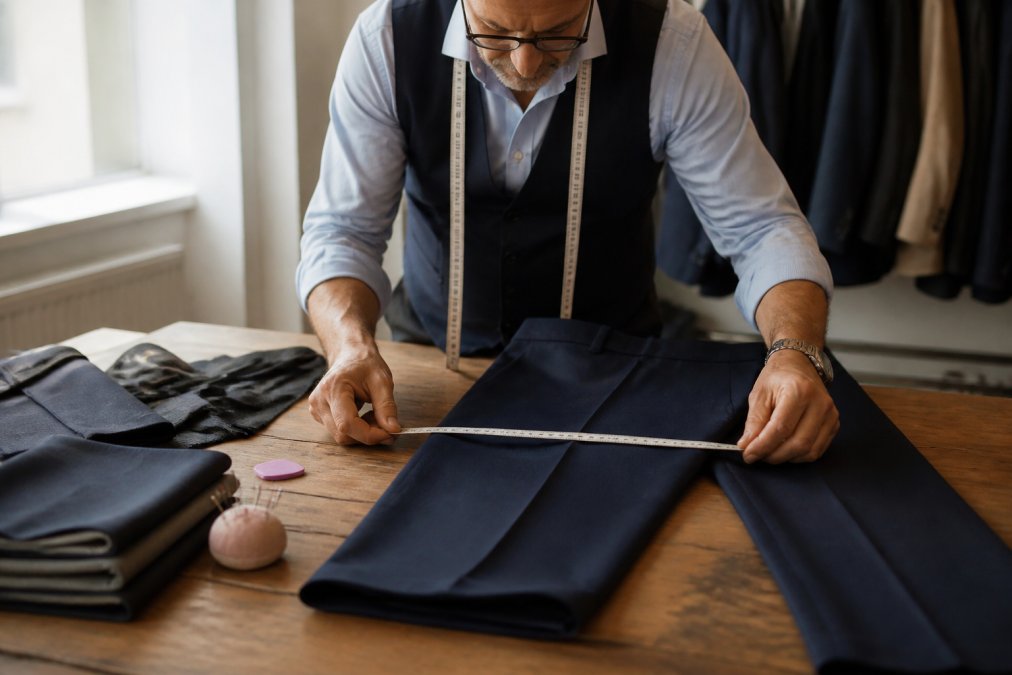
Establishing the correct leg opening relies on a precise understanding of your proportions, which becomes far more intuitive once you measure your body for clothing to ensure the rest of your suit aligns with your natural frame.
Step-by-Step: How to Taper Suit Pants Properly
Follow these three steps in order. Skipping the try-on stage is the single most common reason a taper goes wrong.
Step 1: Pin the New Seam Line
Turn the pants inside out and put them on. Pinch the excess fabric along the inner leg seam, starting at the knee and working down to the hem.
Pin from the outside so you can see the line you are creating. Keep the pins parallel to the seam. Stop at the hem and check that both legs match.
Step 2: Mark, Baste, and Try On
Chalk along the pinned line, then remove the pins. Hand-baste the new seam with a loose stitch so it holds without locking anything in place.
Put the pants back on, right side out. Walk, sit, and bend. If the fabric pulls across the thigh or bunches at the knee, adjust the basting before you go further.
Step 3: Sew the Inner Leg Seam and Finish
Sew along the basted line with a straight stitch. Trim the excess fabric to about half an inch, then finish the raw edge with a zigzag or serger stitch so it does not fray.
Press the new seam flat, then press the hem. Check the length one last time against your shoes.
| Step | What You Do | Time Needed | Watch For |
|---|---|---|---|
| 1 | Pin the new seam line | 15 minutes | Pin both legs evenly |
| 2 | Mark, baste, try on | 20 minutes | Pulling at the thigh |
| 3 | Sew and finish the seam | 25 minutes | Fraying raw edges |
Baste with a contrasting thread color. It makes the temporary stitch easy to spot and pull out once the real seam is sewn.
Suit Pant Break Styles Explained
The break is where your pant hem meets your shoe, and it changes how a taper reads. A taper with the wrong break looks unfinished, no matter how clean the seam is.
- Full break: Hem rests on the shoe with one fold. Traditional and forgiving.
- Half break: Slight touch on the shoe. The most versatile option.
- Quarter break: Barely grazes the shoe. Modern and sharp.
- No break: Hem sits just above the shoe. Best with a slim taper.
For a tapered leg, a half break or quarter break usually looks best. A full break adds fabric bulk right where you just removed it.
Suit Pants Alteration Cost Calgary: What to Expect
Cost depends on the work involved, the fabric, and how much shaping the leg needs. A simple taper on a standard pair is a smaller job than reshaping a lined wool suit with a tricky seam.
Ask three questions before you book anywhere:
- Is the price per leg or for the pair?
- Does it include pressing and finishing?
- What is the turnaround time?
At Calgary Seamstress, we are based in Calgary Southcentre Mall and offer one-hour and 24-hour rush service when you are on a deadline. Our guidance from the Competition Bureau of Canada on service pricing is a useful reminder to always get a written quote before work begins.
If you would rather have the taper done right the first time, our suit tailoring service covers full leg reshaping, hemming, and finishing.
Common Mistakes to Avoid When Tapering Suit Pants
Most taper problems trace back to the same handful of errors. Here is what to watch for.
- Cutting before basting. Once fabric is gone, it is gone.
- Tapering from the hem only. The line should start at the knee, not the ankle.
- Ignoring the lining. Lined suit pants need the lining adjusted too, or it bunches.
- Skipping the press. Unpressed seams pucker and never sit flat.
- Matching one leg to the other by eye. Measure both, every time.
The taper line starts at the knee, not the hem. Get that starting point right and the rest of the seam follows naturally.
Conclusion
Getting a taper right takes patience, and a single wrong cut can undo an otherwise good pair of pants. If you would rather leave it to steady hands, Calgary Seamstress handles suit tailoring, jeans and pants alterations, and rush jobs with one-hour or 24-hour service.
We are a local Calgary small business at Southcentre Mall, and we treat every garment like it matters. Book an appointment online and let us shape your suit pants to fit the way they should.
Frequently Asked Questions
How much should suit pants be tapered for a modern look?
A modern taper usually narrows the leg opening to between 15 and 18 centimetres, depending on your height and build. Taller frames can carry a slightly wider opening, while shorter frames look better closer to 15 centimetres. The key is keeping the line from knee to hem straight rather than curved. Bring your shoes to the fitting so the tailor can match the opening to how the fabric drapes over them.
Can you taper suit pants without ruining the original hem?
Yes, in most cases. A skilled tailor removes the original hem, tapers the leg from the inner seam, then reattaches the hem at the same length. This preserves the factory finish and any original stitching detail. It works best on pants with a generous seam allowance. If the pants are already slim or the fabric is tightly woven, the tailor may need to add a small gusset or adjust the outer seam instead.
What is the difference between tapering and hemming suit pants?
Hemming shortens the length of the pant leg, while tapering narrows the width from the knee down to the ankle. Hemming changes where the pant ends on your shoe; tapering changes how the leg silhouette looks. Many people need both at once, especially when buying off-the-rack suit pants that are too long and too wide. A tailor can usually complete both adjustments in one appointment.
Is it worth tapering older suit pants in 2026?
It often is, provided the fabric is still in good condition and the pants fit well through the seat and waist. Tapering costs far less than a new suit and can bring a classic cut closer to a current silhouette. Skip it if the fabric is shiny, worn at the knees, or if the rise is too low to sit properly. A tailor can tell you in a five-minute fitting whether the alteration will pay off.